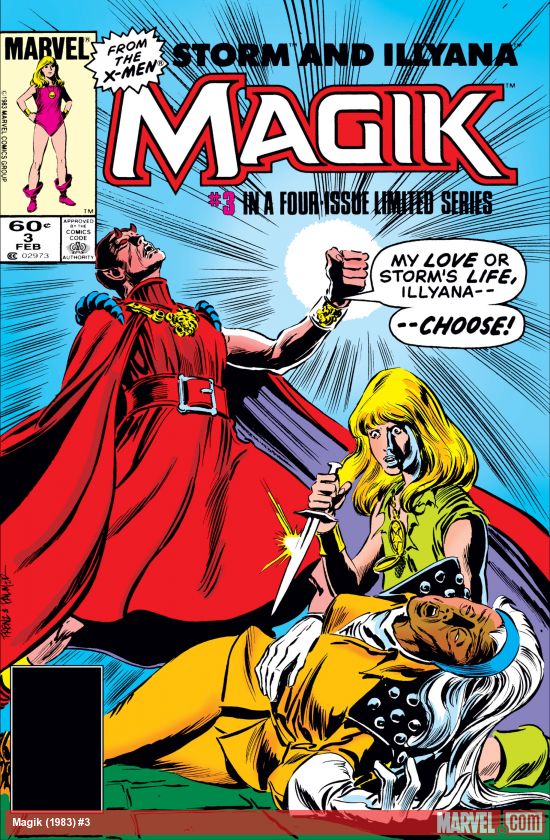
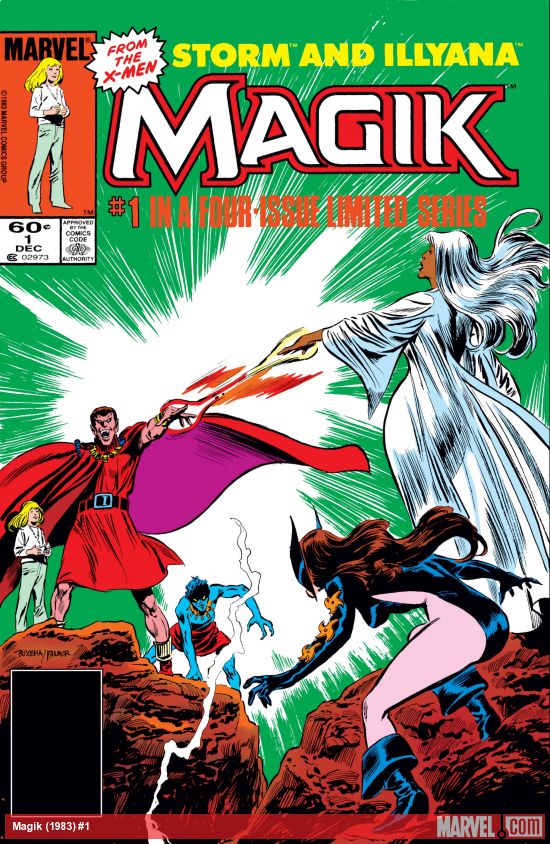
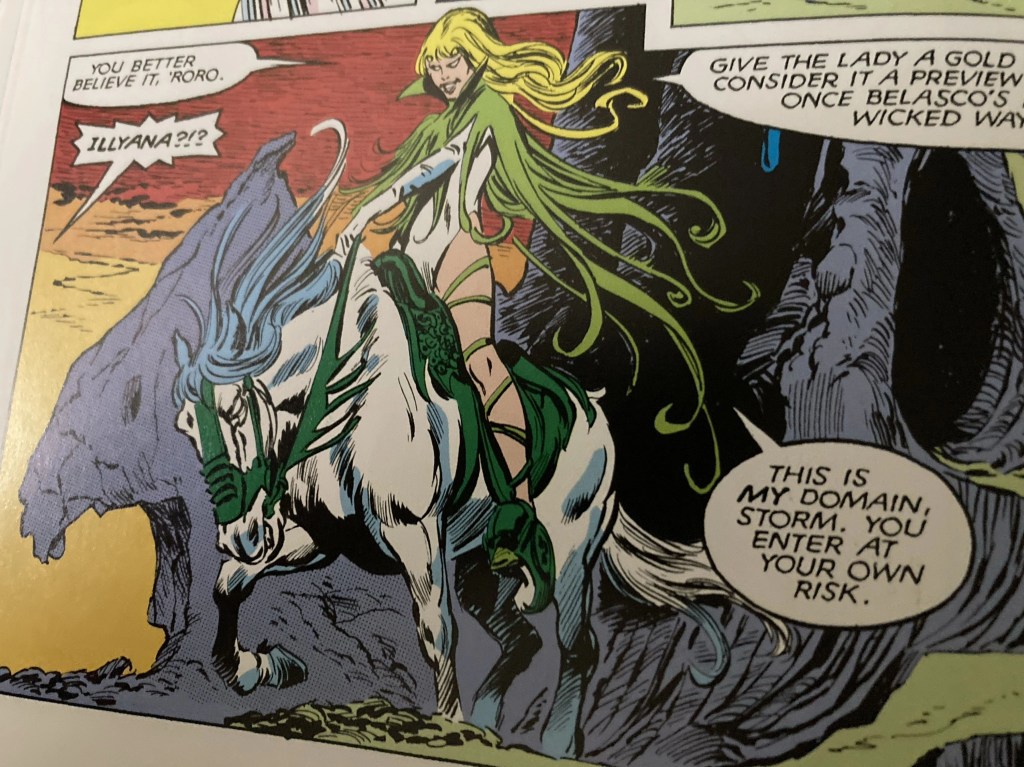
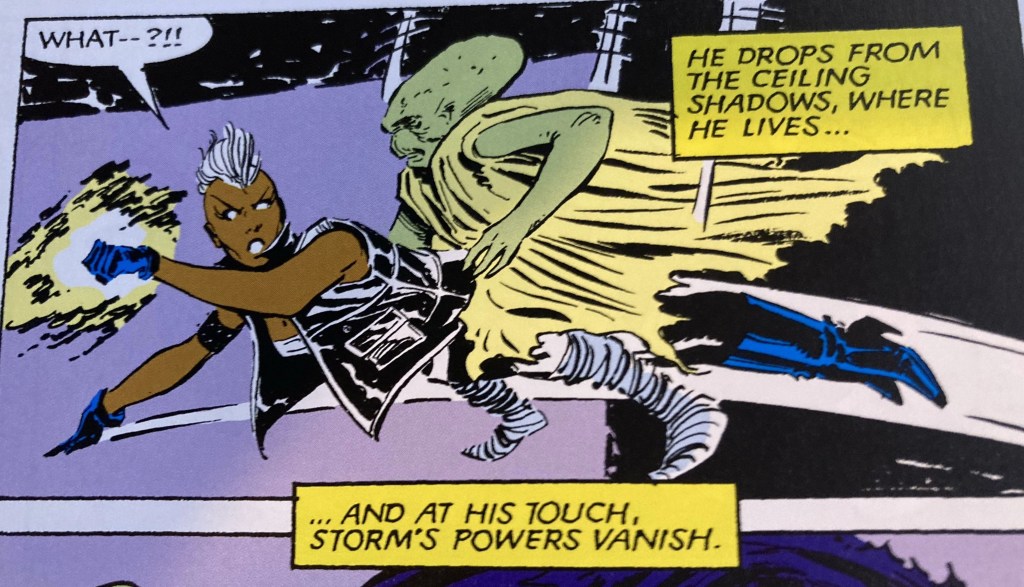
It’s worth noting at this point that the Magik miniseries headlines two characters in the titles. Not just Illyana but Storm.
There would undoubtably have been good commercial reasons to do this – Storm was a popular figure in the bestselling X-men title by this point.
But it also highlights another important aspect of this story. That it presents another aspect to the ‘Illyana as victim of abuse’ reading of the series. Which is the idea of a support network.
Faced with an overwhelmingly powerful abusive individual, characters create support for each other. There are no police here that could be trusted to enforce justice, and the universe itself seems set up to favour the abuser. And yet within the confines of what they can do, Storm and Kitty try to help Illyana get out of the situation she is in.
This assistance is presented as dangerous, and it effectively destroys both characters such is the power of the abuser. But Storm’s actions in this miniseries – to do what she can to protect Illyana – are presented as heroic even in their failing.
Storm’s maternalistic and protective instincts have been part of the character even since she was first presented as an African Goddess. But here they are applied on a smaller scale – about one person struggling against an abusive all-powerful father figure. And it’s a story about the heroism of protecting a single child.
Fun Panel
The tightly packed storytelling of this mini series doesn’t give John Buscema much scope to really draw expansive art on the big panel. So when he gets the chance at the end of this issue he takes it.
None More Claremont
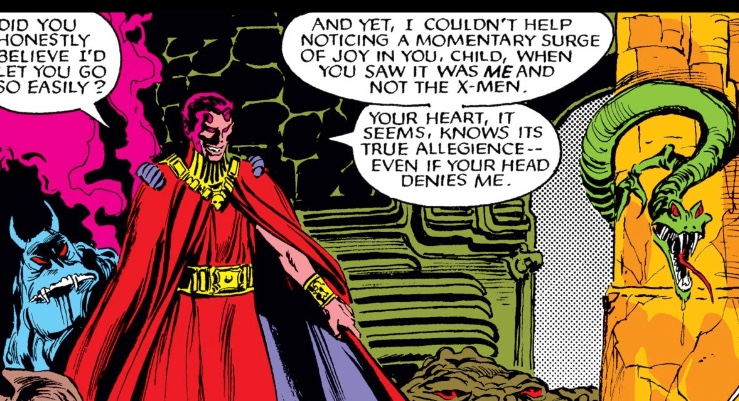
Claremont treads a very fine line throughout this miniseries. Between presenting a tale of child abuse – an absolute No No under the comics code at the time – and that of the temptation of evil. He’s left with hints of the darker reading such as this one.
Claremont’s darkest storyline yet continues with more suppressed evil and hints at something truly terrible. Alongside a couple of allusions to rather viscerally gory things.
Magik’s role as narrator here is quite striking, but also surprisingly dry. One of the elements that develops with the character is her hot-headed nature – her potential to be wild. Alongside trying to deal with her trauma. But here her narration feels somewhat robotic. It’s so matter-of-fact, a first person narrative removed from the character of the person telling it.
There’s probably an element of disassociation here. Magik dealing with her trauma. But at the same time this level of neutrality in the text just makes it a bit dull. There’s no greater indication of this then the fact that in this issue she spends most of her time with Cat, the feline bestrial future limbo form of Kitty. Kitty, by the time of her reflection, is her closest friend. And yet none of that seems reflected in the narration. Which feels a shame.
Claremont is very good at the dry, detached third person narrator – and also at the in-character narration. But here the mix doesn’t quite seem to work.
This gripe should detract from the overall quality of this issue, though. Which continues to explain the mystery of Illyana’s missing years in a fascinating way. The Hellish Limbo is a genuinely unsettling place, and the scale of the imagination behind it is brilliantly captured in Buscema’s art.
I’ve also waffled on about Magik quite a bit here and on the previous blog. And yet this miniseries is also headlined by Storm. And the end of this issues seems to be be setting up her next move. I’m hooked to find out what it is.
Fun Panel
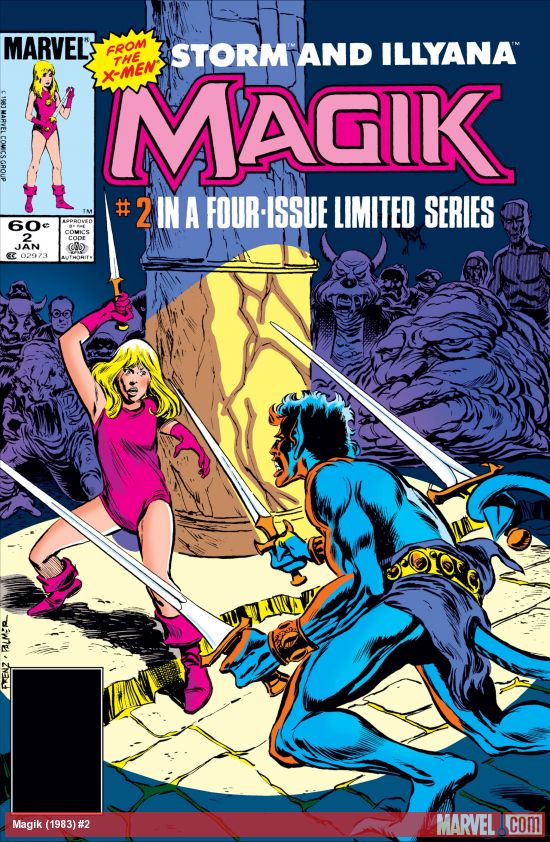
John Buscema is having a whale of a time in this rich, fantasy version of Hell. But especially when it comes to the trippy gateway to leave it.
Any Googling
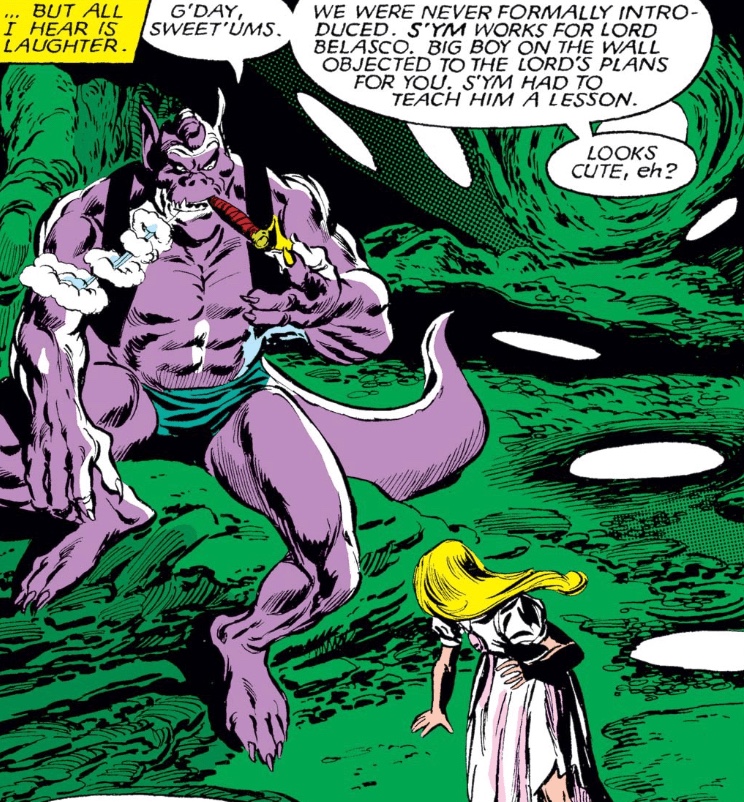
S’ym, the cigar-smoking Demon from Limbo is set to become an increasingly important character as the story of Magik unfolds. It’s quite a distinctive look, and Google suggests that the origins of the character in a homage to David Sim’s Cerebus the Aardvark.
It’s quite an odd homage. It’s understandable that the title might want to reference one of the most popular alternative titles at the time, an indie success that would have seemed like a very cool name to drop. The character seems to scho some of the speech and visuals stylings of the cult aardvark, without becoming close enough for Marvel to have to pay out.
But there’s probably also an element where this is a bit of revenge. In an earlier issue of Cerebus, Dave Sim had introduced the character of Charles X Claremont. Who disguised as a woman serves as a headmistress at the “School for Gifted Debutants”
There’s often an element of good-natured ribbing in such cameos, although in this instance there may be something slightly more venomous. Sim stated he wanted to mock Claremont’s tendancy to ask why any new character being created couldn’t be a woman. Sim’s subsequent more controversial comments regarding woman being “voids”, empty of creativity against men, who are creative lights. Goping on to sneer at men who he felt were dominated by their wives, in a manner that seems all to relevant these days.
Meanwhile S’ym never stops being a morally repugnant villain. Although probably to avoid legal matters has never been presented as the recognisable incel-style misogynist.
None More Claremont
This issue brings back (and kills) the twisted version of Nightcrawler. The wicked character from the earlier issue of X-men that tried to sexually assault Kitty. Whereas that appearance raised very difficult questions as to how much this behaviour was innate to the character, or an abherration added by Belasco – this issue suggests a possible get-out for this quandary. When the older limbo version of Kitty tries to attack Belasco, he simply gains control of her body and turns her into a full on feline character. He isn’t revealing any hidden nature within the character, just destroying her and replacing her with something new.
It makes this horrible Nightcrawler easier to accept. But this “how much evil truly lurks in the hearts of good people” is a question Claremont repeatedly comes back to. Without ever fully addressing
Illyana Rasputin (aka Magik) remains one of the most interesting creations of the Claremont run.
In part that’s because it’s an original idea and also because the character got their story told within the run. They have subsequently returned to the franchise, rehashing elements of the Claremont tale while also frequently sporting a cheesecake sexy look, a mutant Demon Girl Vampirella.
But the fact that, unlike so many others, Magik gets an in-Claremont run ending means that there’s scope to look at that whole story.
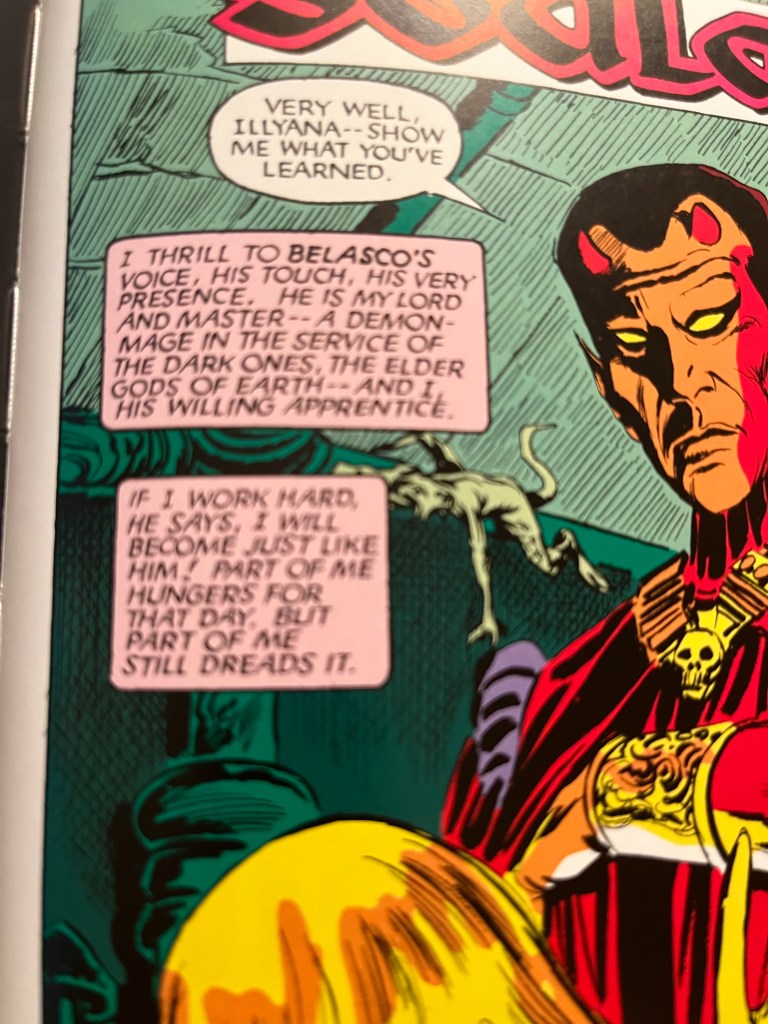
Which comes back to the original tale – and why it lasts. Because it’s dark. Not “I’m going to kill a lot of people in a grim n gritty way” dark that was to define a lot of the era (and is still, depressingly, the easy way for comics to play dark). But dark in the sense that it tells a tale of lost childhood. Of an abusive adult taking a small child away from her family and using her for his own ends.
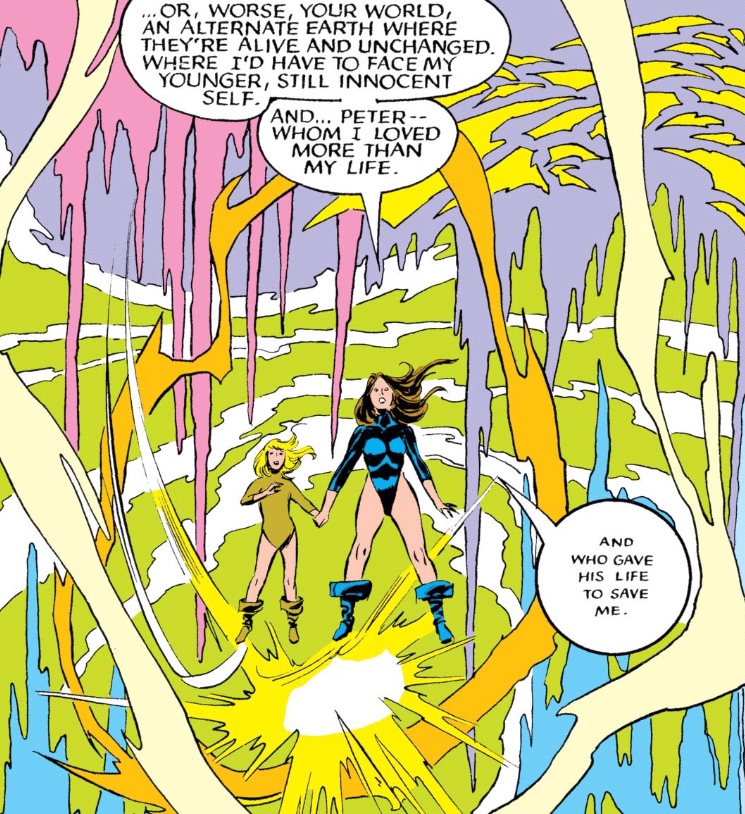
The older I get, the darker this reads. The speech bubbles where Magik talks of wanting to do anything to please Belasco are genuinely chilling.
This mini-series is pretty much the Magik origin story. It sets up storylines that will run for some years and gives us all the essential details about the character. Indeed most of that is covered by the end of this issue. An unsettling re-read.
Fun Panel
Any Googling
Inevitably with the growing franchise of comics, the question of reading order comes up. Where should mini series like this one be placed in any chronological reread.
One of the problems is that these things never quite fit perfectly. There’s no *right* answer. A lot of complete lists I found on the internet put this series right next to the issue of X-men where Illyana enters limbo.
However that doesn’t fully satisfy me. There are a few times in subsequent issues where they play with the mystery of what happened to her. This works well as the build up to this mini.
Also the framing sequence in this mini seems to fit perfectly with New Mutants 14. Which is why i placed it just before that issue in this blog. It might not be the “right” answer. But it works for me.
It was a Product of its Time
More Naked Storm. It must be double figures by now.
Back to the New Mutants, and its striking that this issue really feels like the title has found a voice. It knows what it is. It is a teen drama set in a school, with occasional powers.
Now that we live in a post-Buffy world, this format would seem a no-brainer – but back then it really feels slightly odd to be reading a comic that frequently wants to tell stories on such a low level. It’s teen kids struggling with their life, and thats the drama. With occasionally flashes of super heroic excitement.
So influential has Claremont been that re-reading this now feels incredibly like reading a pitch for a new TV show. And yet, back then, its hard to see that could possibly have been on Claremont’s mind. It seems like this was seen as a direction to take a comic in, a direction that feels suprisingly novel.
Of course part of that novelty is that comics have unlimited special effects budgets, and so its interesting to see a title exercising restraint. To enjoy itself telling stories of folk chatting in kitchens, or crying the bedroom because they don’t fit in.
Conversely without the scope to adapt it to a TV show, it would be interesting to see how the title was doing sales-wise. There’s a big change coming soon which suggests to me that it didn’t quite land as well as Marvel wanted. So they tried something else. Which is a slight shame when you have an issue like this one where things do seem to be clicking.
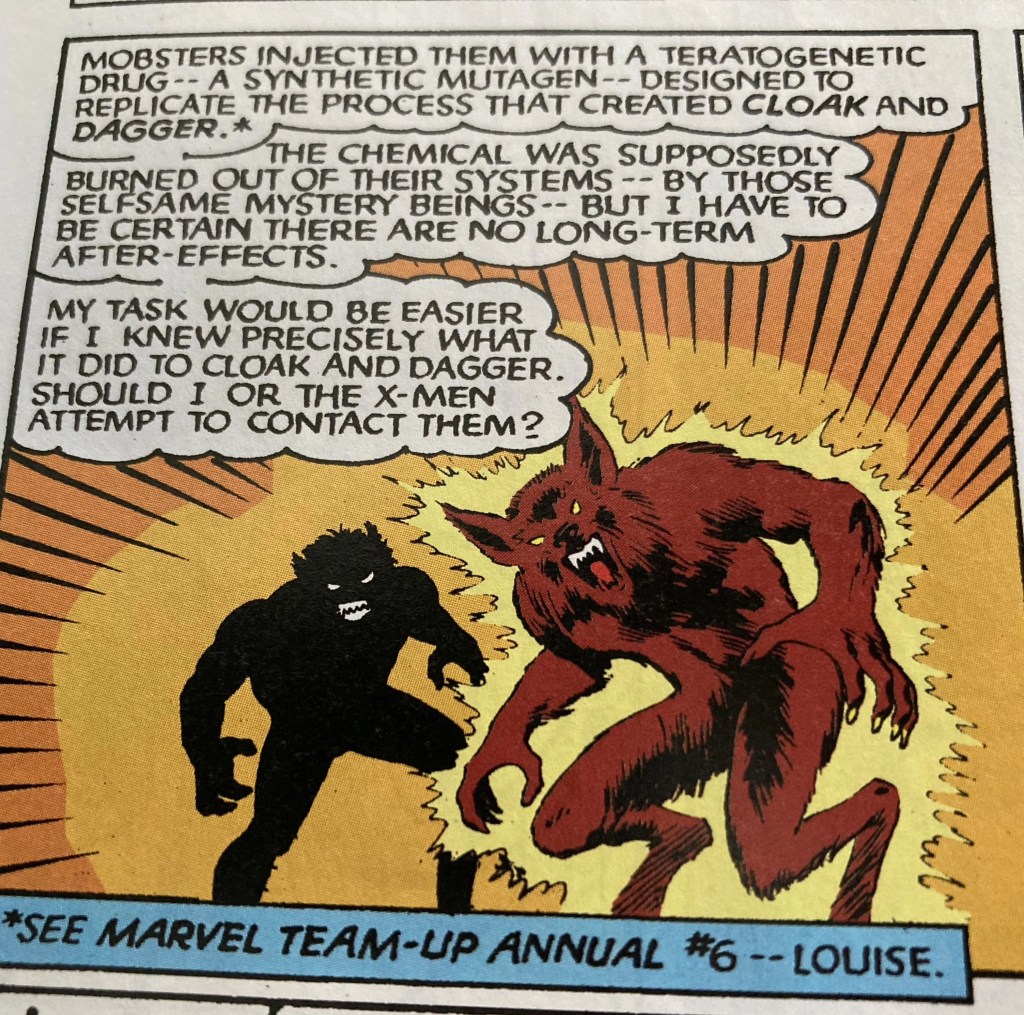
Of course, this being the inter-connected Marvel universe, even a title playing at this low-level student melodrama can’t help but drop in whats happening elsewhere. In this case big pulp sci-fi Jekyll & Hyde corrupted drug serum hijnks. The issue itself is worth a read, not least because its a development that the title is going to return to. But its also nice to see Cloak and Dagger, a duo that are based on a great concept that has never quite had a great realisation.
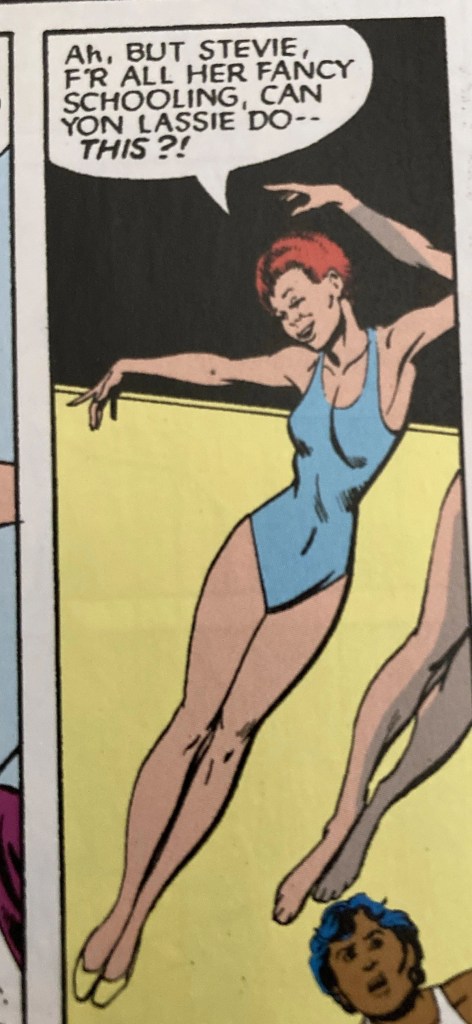
There’s also a slightly Product of its time moment in the Annual where we are told in no uncertain terms that Cloak and Dagger are the same age as the kids in the new mutants. I know they are meant to be young – but making Dagger that young, especially given her outfit, it quite a choice. Nobody seems to have told the artists this fact, given she’s drawn as a (disco-inspired) sexy woman. Contrasting her presentation with the female New Mutants alongside her underlines perhaps how atypical the presentation of the new X-team is being.
Fun Panel
That Don’t Make A Lick of Sense
Honestly, I get increasingly perplexed about what exactly I am meant to think about Rahne and her extreme religious upbringing. One moment she can barely bring herself to talk out of fear for irreligious disrespect, the next she’s comfortably dancing around in a very non-presbytarian outfit.
A character challenging and questioning her extreme religious faith is an interesting take – but it probably is something that would require the character to have their own title. A title the character just doesn’t seem popular enough to justify. A mini series where she eventually found a way of reconciling her faith with her modern lifestyle. But this whole aspect of her character gets short-changed by making her just one of a team, where we drop in and out of her religious turmoil as an aside during the team’s plot.
Any Googling
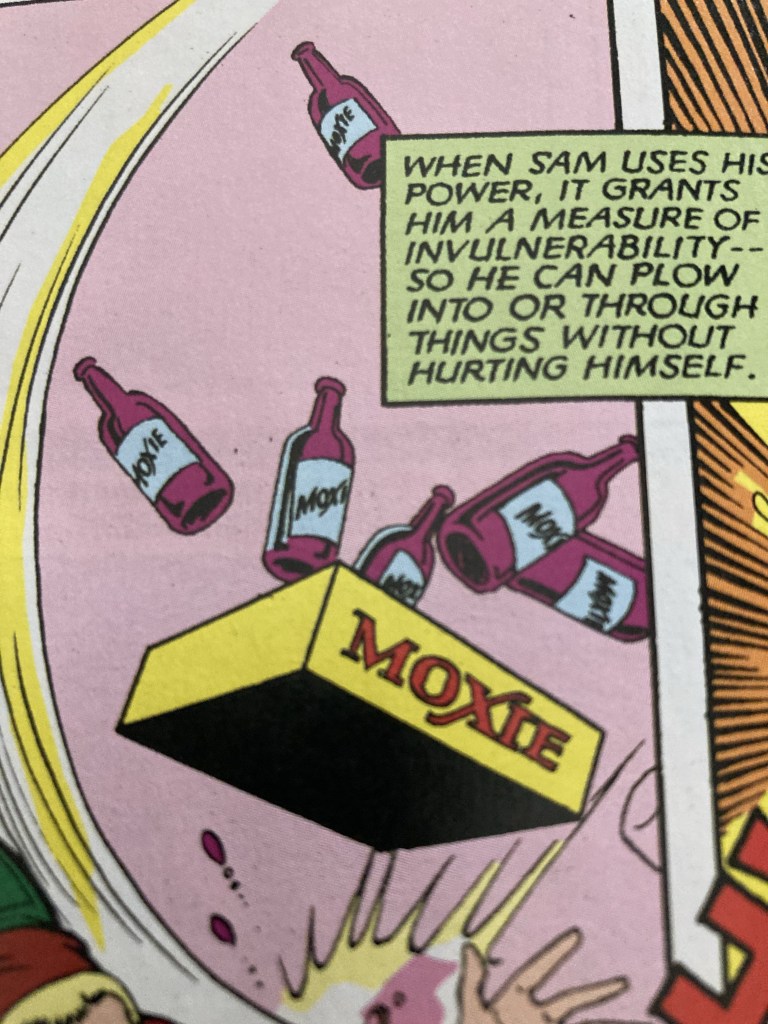
As a non-American, Moxie is the stuff of minor legend. As a fan of old films, the phrase “they’ve got moxie” is known to me and its fascinating to find out the expression was based on a fizzy drink that emerged on the market before Coca Cola.
Both the classic vernacular and this appearance made me very keen to try and drink some moxie. According to the internet, the company still exists, having been bought out by Coca Cola in 2018. But its hard to now quite whether it still survives and is available. And if it is, it does seem to be limited to its historic stomping ground in New England.
Sadly it does not seem remotely possible – or economically feasible to ship the stuff over to try some. Maybe one day!
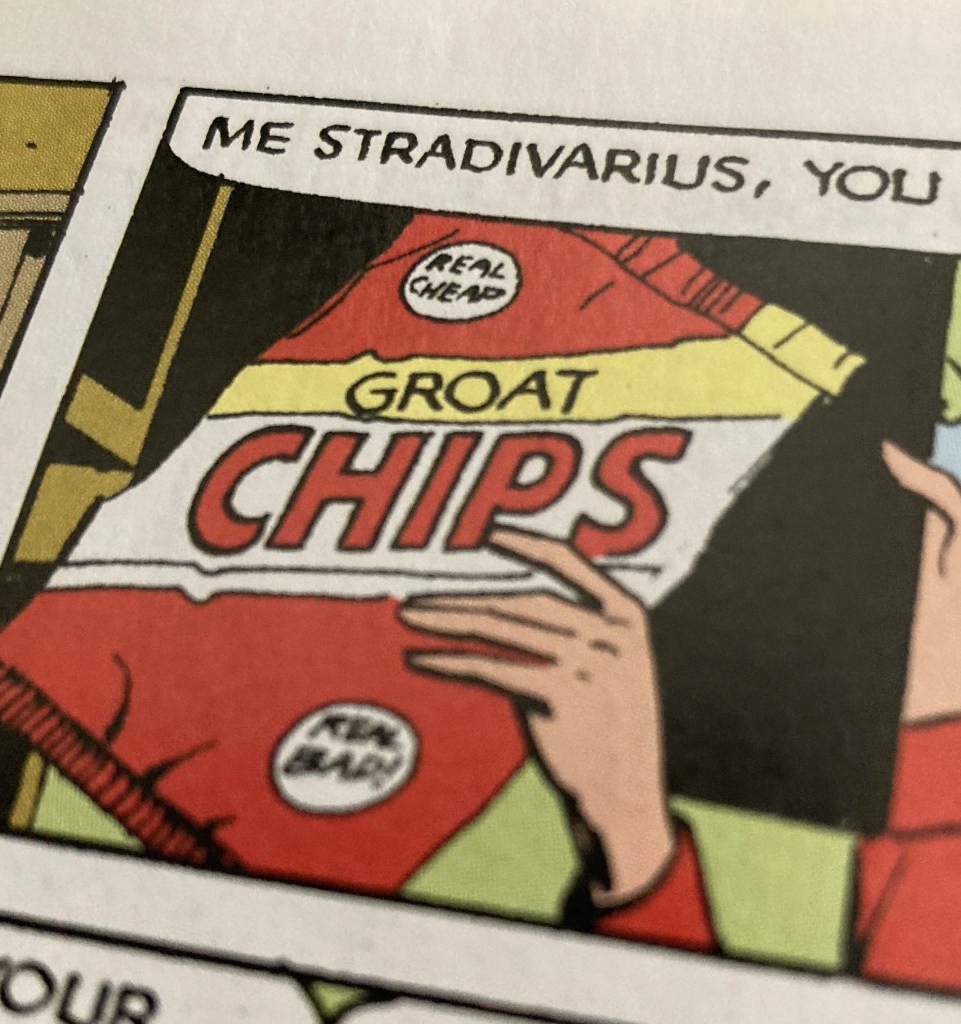
On the other hand, googling Groat Chips suggests a process that makes animal feed. I’ll passon trying those!
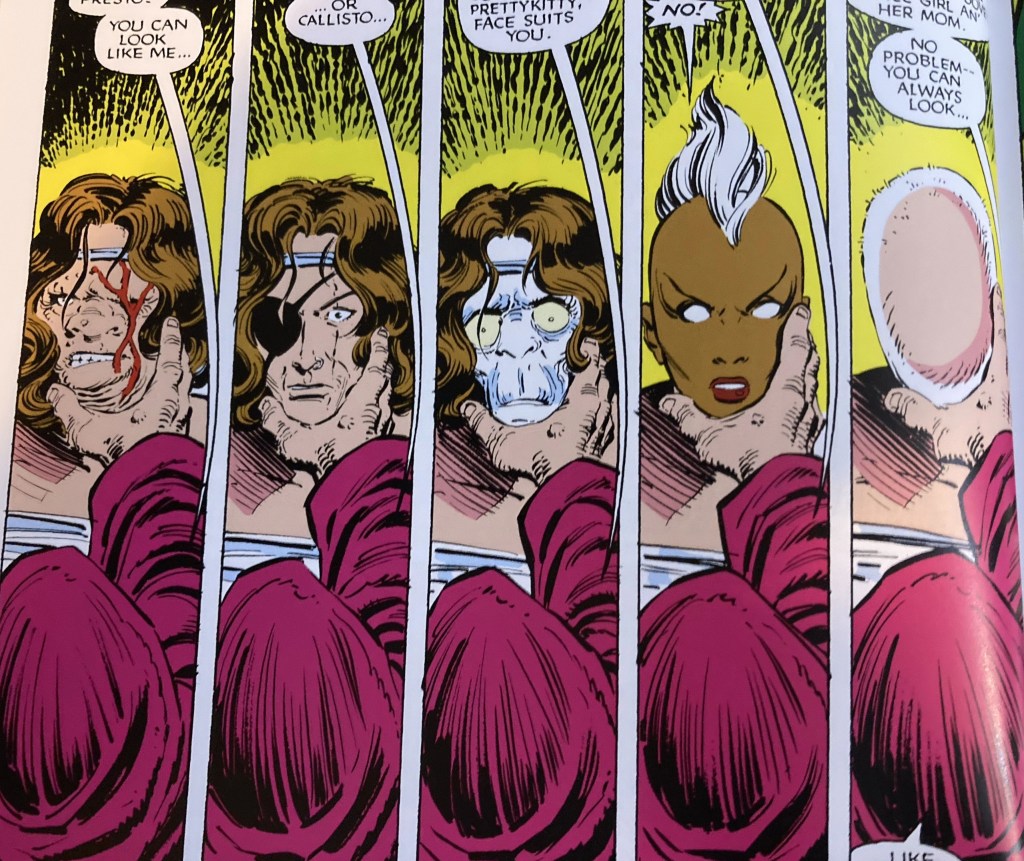
Claremont is back to his granny music in this issue, with a sentimental tale about a poor ugly Caliban hopelessly in love with Kitty Pride, who finds a fairy tale redemption at the end.
It runs the risk of being trite but avoids it mainly thanks to two great pieces of character writing. Firstly Kitty Pryde’s reactions to events at no point feels like it’s being contrived or forced to fit into the fairy tale narrative. Instead it remains that of a teenage wannabe super hero who just now happens to have to find her way through a very fairy tale scenario. She’s a great audience identification figure throughout, and her final sacrifice comes across as genuine, brave and relatable.
The other aspect that stops it all getting to mawkish is that the main antagonist Callisto is straight out of the darker world of fairy tales. She exists in a universe of cruelty and death, rather than a more sanitised Disney-esque take on the genre, tapping into earlier version.
But even then she’s not wicked for the sake of wickedness. Her character – and especially her anger – gets a full outing here. A leader of the outcasts that make the X-men seem mainstream, who has been toppled by those very same “socially acceptable” X-men. It makes for a great antagonist.
Alongside that, John Romita Jr has a field day with the grotesques of the morlocks. They’re a fine motley crew of interesting powers and stereotypically monstrous looks. From a pretty two dimensional set-up, they’re a fascinatingly diverse lot in looks (and powers)
Fun Panel
That Don’t Make A Lick of Sense
As someone who came on board the X-men originally in a few years time, this version of Leech is truly bizarre. He’s far far away from the “Green Twin” to Artie that he becomes. Here he’s very much the basic morlock. Sad, weird looking. While it’s a great power it’s a bit too much of a cliched character to not mourn the reinvention.
Mutant Mailbag Mayhem
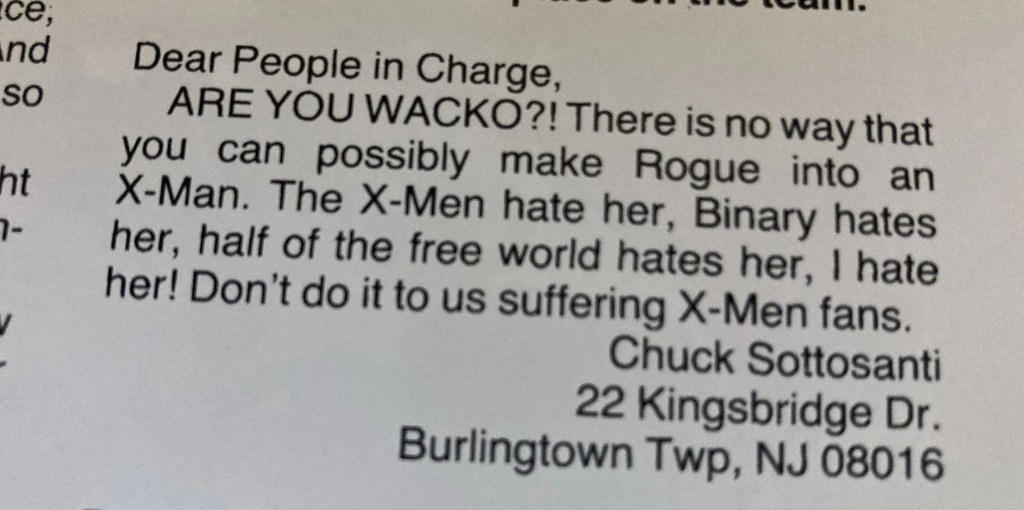
ARE YOU WACKO! A small corner of New Jersey has lost it over Rogue joining the team. I hope Chuck Sottosanti stuck around.
It’s felt a while since a proper slugfest and this issue delivers – X-men vs Brotherhood. Claremont always seems to enjoy bringing new powers to the fight, and that – combined with our established X-men becoming more comfortable with their abilities – makes for another fun, inventive fight.
This isn’t just an issue about fighting, though. Mystique has plans. But Callisto also has plans. Two villainous women, pursuing defined agendas and with a clear, interesting motive. The only downer really is that both are seeking a very embittered revenge, but it’s a minor gripe. And one more than offset by the sheer imagination they’re putting into their schemes.
It ends with another “could this character possibly be dead” cliffhanger. But rather than just dropping it at the end to create a cliffhanger (only to conveniently reverse it within three panels of the next issue), this feels like an important plot point. Something terrible has happened, but we don’t quite know what. And finding out will pull us back to the next issue.
Fun Panel
That Don’t Make A Lick of Sense
Erm… what’s going on with this picture. Is that… Maddie’s arm reaching across!!
Mutant Mailbag Mayhem
Angel on the letters page does more than he did in his recent stint on the team. Well done, Warren *pats head*
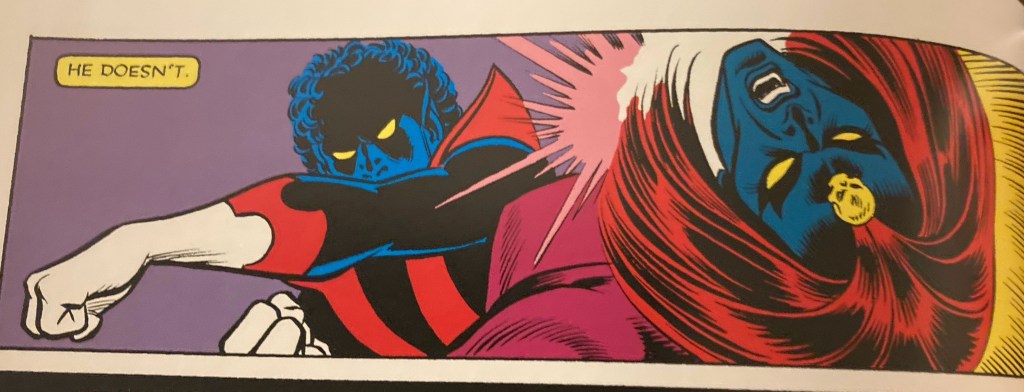
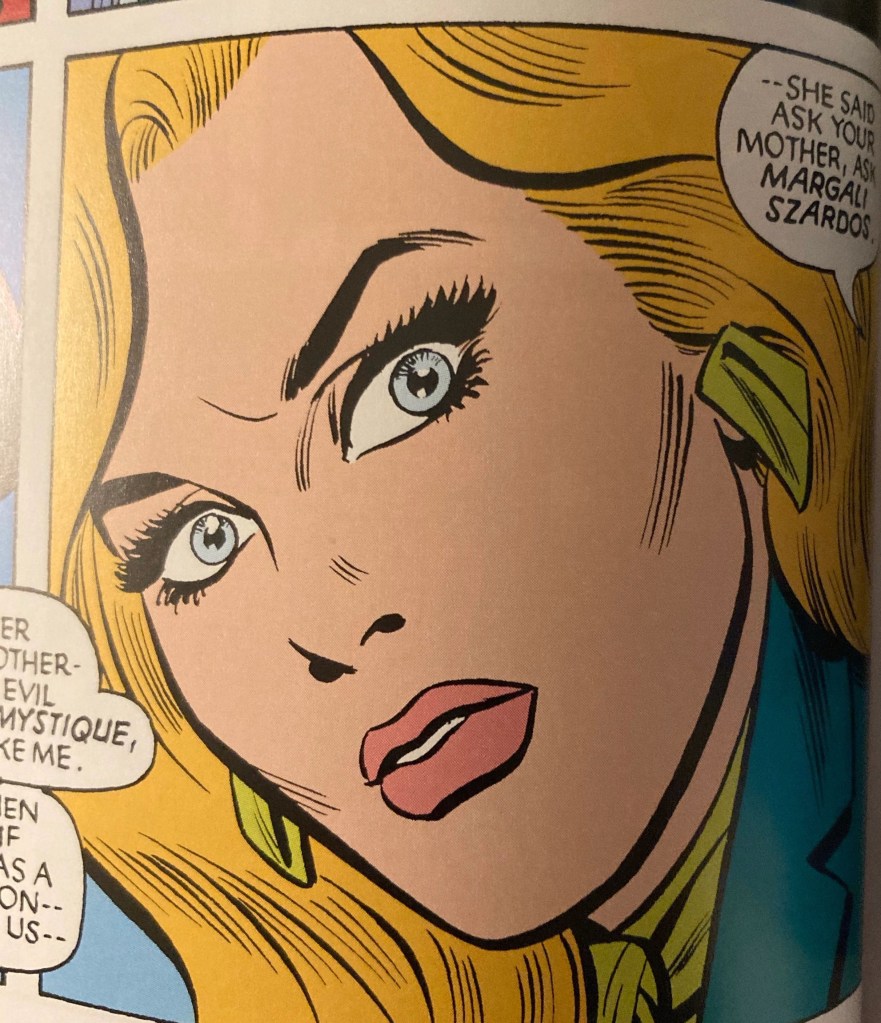
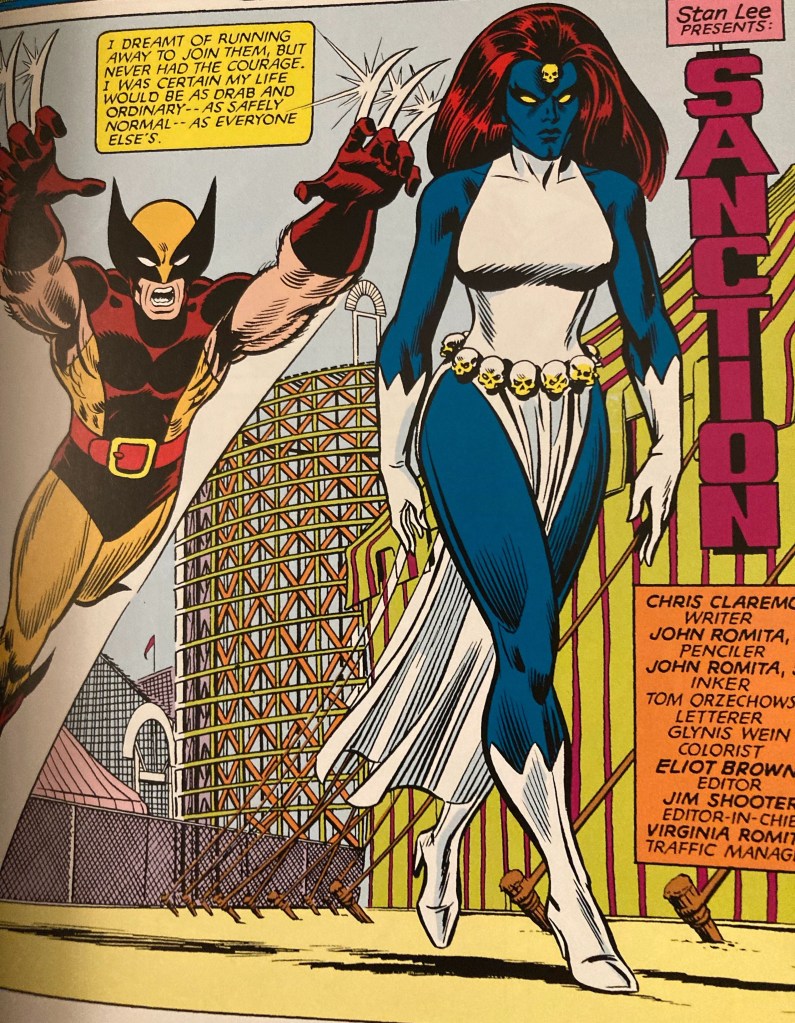
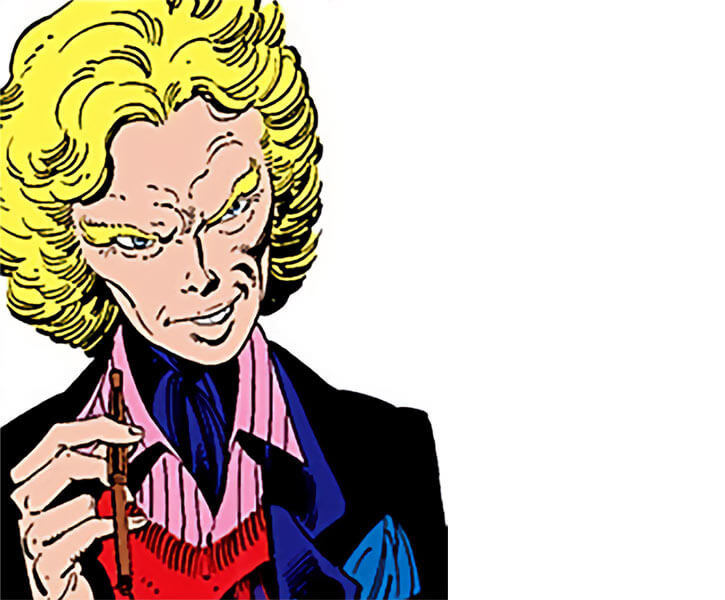
Mystique, Nightcrawler, Arcade Oh my! This is how you get me to like an issue. There is so much great stuff in this, especially when it comes to developing the characters of Mystique and Nightcrawler.
The opening sequence is great – a thrilling action sequence that you know can’t quite be real but even the curtain being thrown back on what is really happening is a delicious moment.
John Romita Jr continues his new stint on art duties. But it all seems somewhat different this time. Simpler, clear lines that suit a Sixties pop art colour. A quick look at the credits suggests the reason why – John Romita Sr is on inking duties this issue. For someone like me without a background in art, this maybe gives an indication of quite how important inking is. A different name on inking duties can radically change the impression the art gives.
Fun Panel
That Don’t Make A Lick of Sense
Pyro returns with all the usual suspects in the Brotherhood of Evil Mutants. Except this Pyro is changed somewhat. Rather than the arrogant posh stereotype of his previous appearance – he’s suddenly become noticably Australian.
This being Claremont’s global outlook, his Australian nature is illustrated by a healthy lexicon of Australian vernacular like ‘cobber’. He’s unambiguosly changed, and at no point is that explained.
Looking into the characters origins provides some clues. Pyro original look came from Byrne, who in a regrettable dated stereotypical way decided to draw him as a homosexual. Reading something different in this loo, Claremont decided to make him British. Not only that but feeding into another stereotype – that of a louche, posh degenerate.
Maybe its that awkward origin that meant that it was decided to revamp the character. It’s harder, though, to find the story of who decided on the change. The first mention of Pyro’s Australian nature predates this issue – appearing in his profile in the Official Handbook Of The Marvel Universe.
Was this a mistake? Did the person who drafted the article misread the venacular of the character’s first few appearances, and decide they were the sort of person who came from Sydney? Or had editorial decreed by this point that the change should be made?
Or did Claremont just decide he wanted to have an Australian mutant in his globally-minded title? And in those days before reprints, the internet and ready access to all back issues, did he decide that this change didn’t require any explanation.
Whatever was the reason, its an interesting, inexplicable change.
One of the aspects of this re-read that’s been fascinating is watching the evolution of Cyclops under Claremont.
On paper, he’s a full character. The Head Boy. The Teacher’s Pet. If the x-men are teens, he’s the one in the car suggesting that we really shouldn’t be stealing traffic cones. The one reminding everyone of that video that was shown to class explaining why playing on building sites might not be smart.
It feels inevitable that such a character would become leader to the teens of the original line-up. But when the title relaunched Cyclops found himself in a team of adults. The dynamic changes.
Claremont’s strength when it comes to the character was in recognising that, and writing on ongoing tale about how that Boy Scout develops in that scenario.
He doesn’t do anything obvious like “break” Cyclops. He doesn’t revamp him to make him seem grim and gritty and cool. He creates a flawed leader of the team.
He’s still the Head Boy at the school but Claremont shows a resourcefulness and self-sacrificing quality that shows why he makes a great Head Boy.
And he humanises the character. He gives him a long-lost father, breaks his heart, gives him fellow team mates who don’t even seem to respect him.
And then, when he leaves the team, Claremont doesn’t have him leave the book. His adventures in the wider world are a nice combination of a character healing and growing.
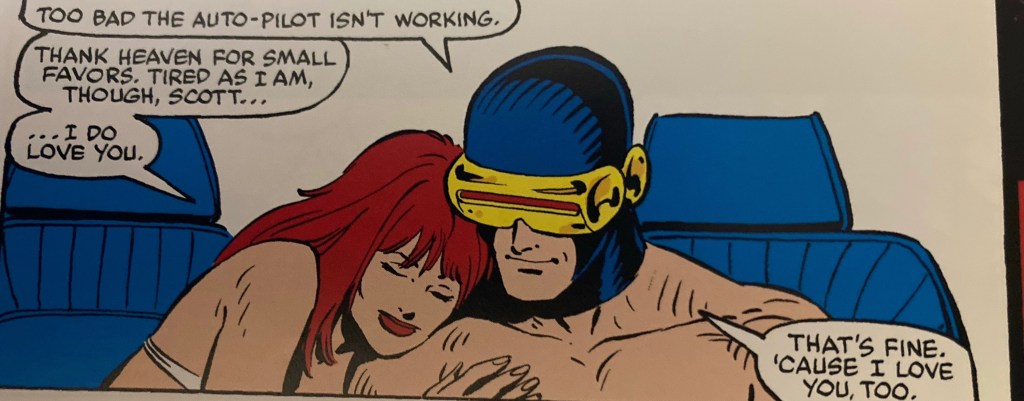
A journey that takes him here. Effectively showing him leaving the team for a happy marriage. There’s a lovely dynamic between the two here, presenting a credible relationship between two people who love each other and, crucially, enjoy each others company.
The epilogue of the Dark Phoenix Saga looks back at the history of the character. Whereas this epilogue to the From The Ashes storyline points only to the future. A happy future away from the adventures of the main title. An ending it feels like Cyclops has earned. I think it’s genuinely inventive and great writing.
Enjoy it while it lasts though. Kurt Busiek and the Marvel Editorial team are lurking in the shadows to one this screw this all up.
The action switched this issue from high adventure in the deepest Amazon, to team melodrama in contemporary Rio. It’s a nicely drawn portrait of the city here, by Marvel standards. There are recognisable stereotypes, but we’re not talking the extreme examples of Scotland, Irelanc or Germany. The issue genuinely tries to portray a modern city, with modern city problems.
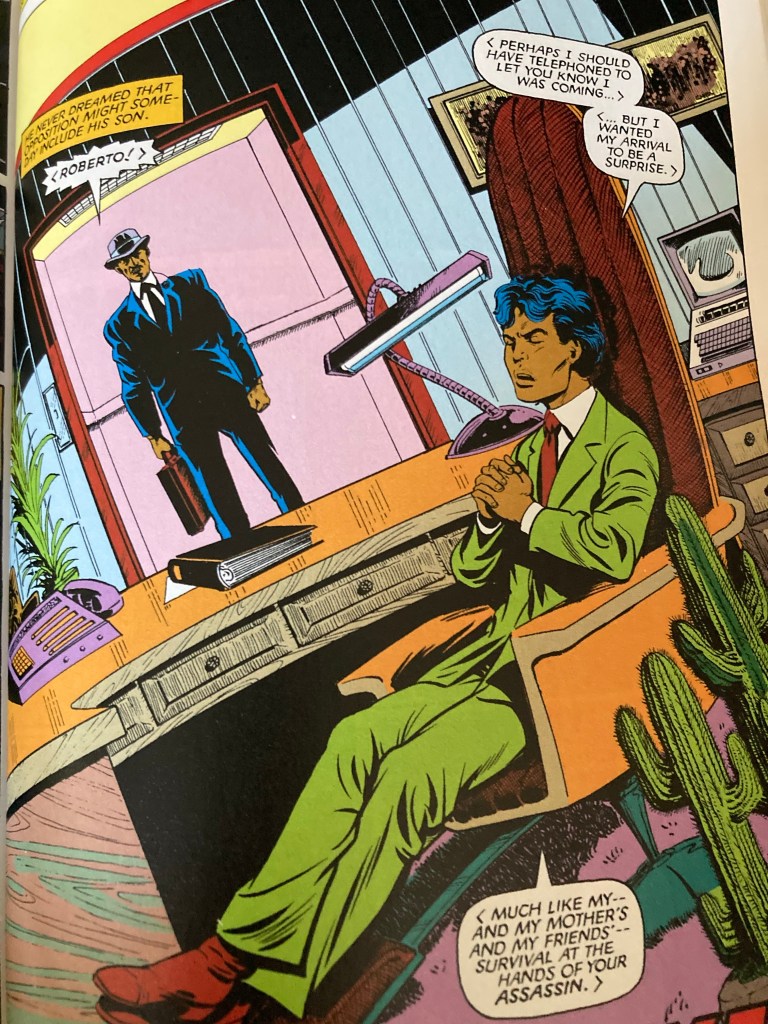
Problems that include Sunspot’s father – being set up here as a member of the Hellfire Club, The father/son relationship being presented here is interesting – contrasts that you feel could set up some fascinating storytelling. His father is ruthless, cynical but smart and measured. Sunspot is hotheaded but also an idealist trying to do what’s right. Reading this back it feels a shame that I don’t think its an antagonistic family dynamic they ever fully explored.
I do find it more interesting, though, than Rahne’s extreme religiosity. Her strict presbytarian upbringing only ever really seems to manifest it in her being shocked by the modern world, followed by lot of internal self doubt and loathing. Rinse and repeat. She does this again here, slipping into a Catholic church (!!) to pray. Making religious doubt central to a character feels like something that could work for the lead in a title but its a tricky thing to focus on in a team book, meaning the concept never gets fully explored. Whereas Nightcrawler’s positive Christianity can be a useful feature for the character and his role in a team dynamic – Rahne is just limited to how her strict beliefs can interplay with the others. Which just means seeing the same thing over and over again, without any interesting payoff.
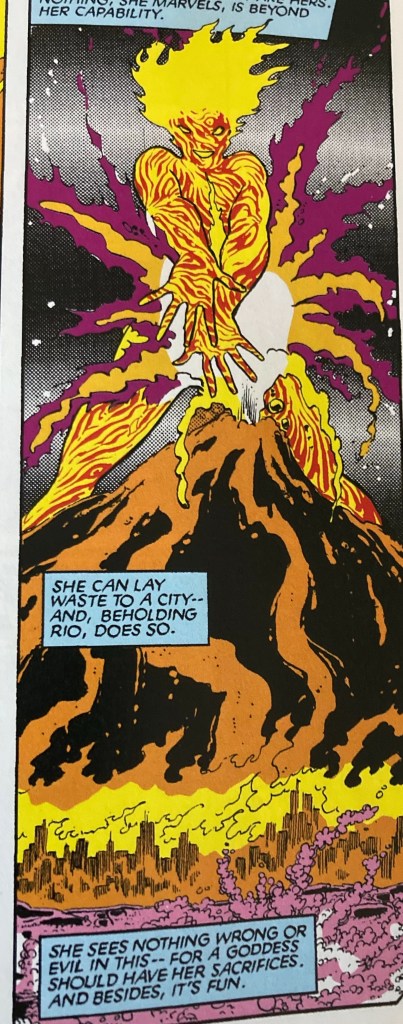
Finally the issue focuses on Amara – a stranger in the modern world. Struggling to cope with both it and her new mutant powers. There’s some nice moments of mutant alienation that suit the title although its a slight shame that the storyline agains seems to head in the direction of woman becoming too all-powerful and that engendering corruption and disregard for life. We’ve already been here with Phoenix, Storm and Carol Danvers. This adds little new, especially as we still don’t know much about Amara yet.
Fun Panel
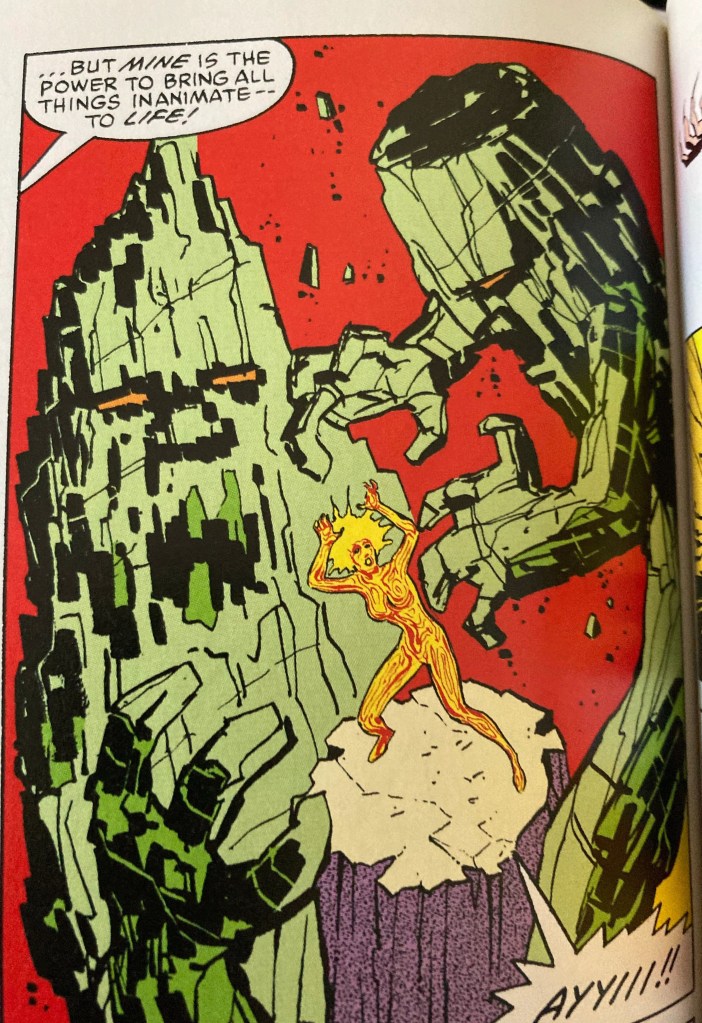
A great image of fantastical excess – not something Buscema gets a lot of chance to do on the title.
The pulp epic that is the New Mutants in New Rome comes to an end in this issue, sticking wholeheartedly to the b-movie template. There’s a big showdown with the villain, or rather with two villains. The threat to New Rome is defeated and the Vampire is seemingly killed – although tellingly nobody gets to see a body.
It feels slightly overstuffed at time, but in a good way. Reading it, I feel that loads more could have been made by so many different aspects of the story – for example Rahne as Roman God. But wanting more from a story is a pretty good sign of strong imaginative storytelling.
Amara seems to have joined the team at the end, which is intriguing. Such is the complexity of her backstory, its going to be interesting how committed the next few issues get with taking seriously the fact that her origins are so alien. Will she return to the mansion and within a few issues simply be the beautiful blond American teen?
I guess Claremont probably felt there was more mileage having such a character as an outsider as he was finding it possible to write for when it came to Karma. It’s also a lot easier to avoid stereotypes when your foreign character is from an entirely fictitious and fantastical foreign land.
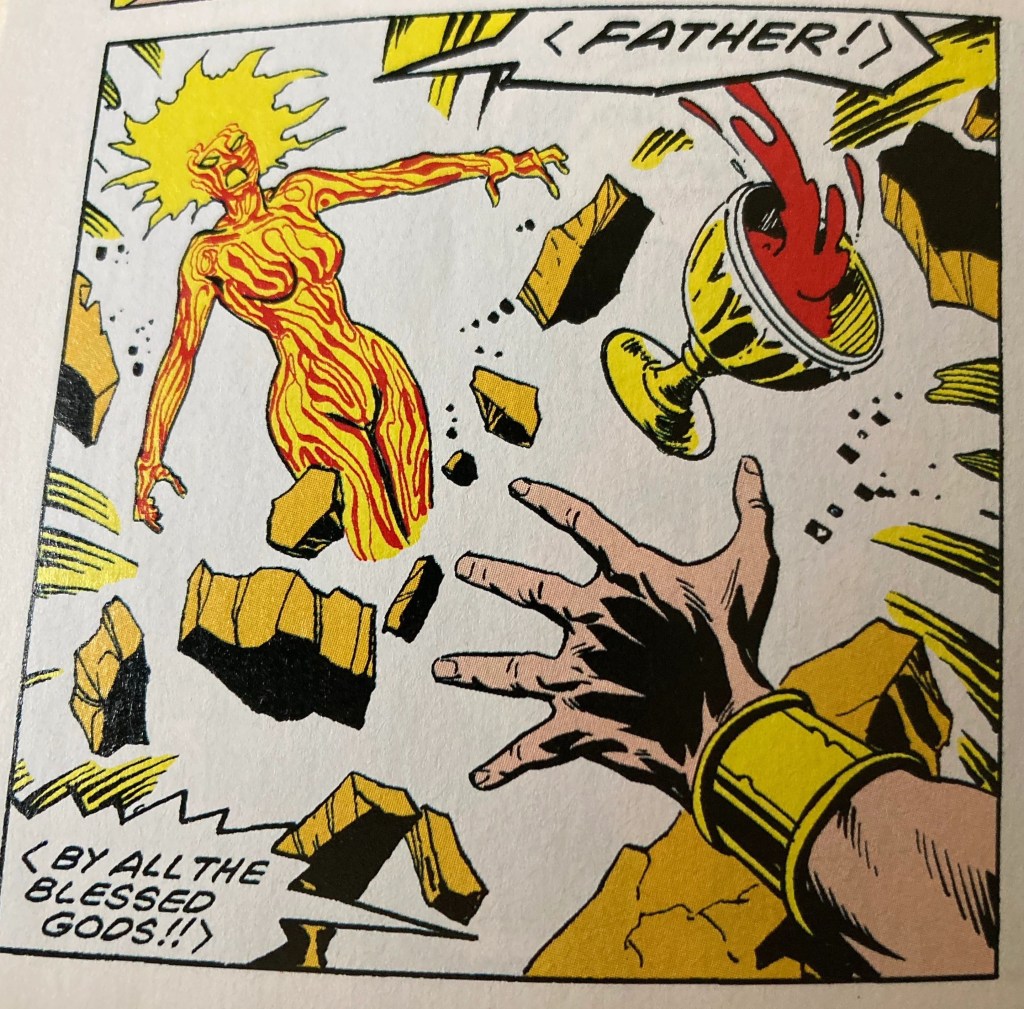
Fun Panel
Every now and then its great to take time out when reading a comic and reflect on the image you’ve just looked at. And consider just how brilliantly barking mad it is. In this case, Girl who has just discovered her body can turn into Magma bursts in on her Evil Father, who happens to be plotting to make himself Emporer of a South American outposts of the Roman Empire hidden in the Amazon. Thereby thwarting his plan to poison a Boy who canfly by turning his legs into thermo-chemical energy.
Wonderful.
That Don’t Make A Lick of Sense
Selene is going to go on to have a part in the X-universe, but its worth considering just how insanely powerful she is. She can manipulate all inanimate matter. She can mind control. She can drain the life force from others to make herself stronger. And yet she always remains a minor tier threat.
None More Claremont
Claremont is back in his world of cosy comics-code-friendly Domination here. An older woman preying on an adolescent is already eye-brow raising so its interesting how far they go into defining the predation as full-on temptation and pleasure. On one level, Selene has been described as a “vampire” and this is all well within the scope of established Vampire storytelling tropes. But it feels slightly clumsy to then present it in this context, with the seduced being an underage girl in a bikini. The unbroken link described here doesn’t really become an element going forward, though. Claremont already had Magik to explore these ideas, so its probably a relief they didn’t go down this road with another teen character.

















 The X Marathon